

For decades, Japan occupied an unusual position in the global economy.
Interest rates remained extraordinarily low. Government bond yields stayed far below those seen across many other developed economies. Inflation was often something policymakers wanted more of, rather than something they were trying to contain.
That environment shaped Japan’s economy and its relationship with global financial markets for years.
Now, several of those conditions are changing at the same time.
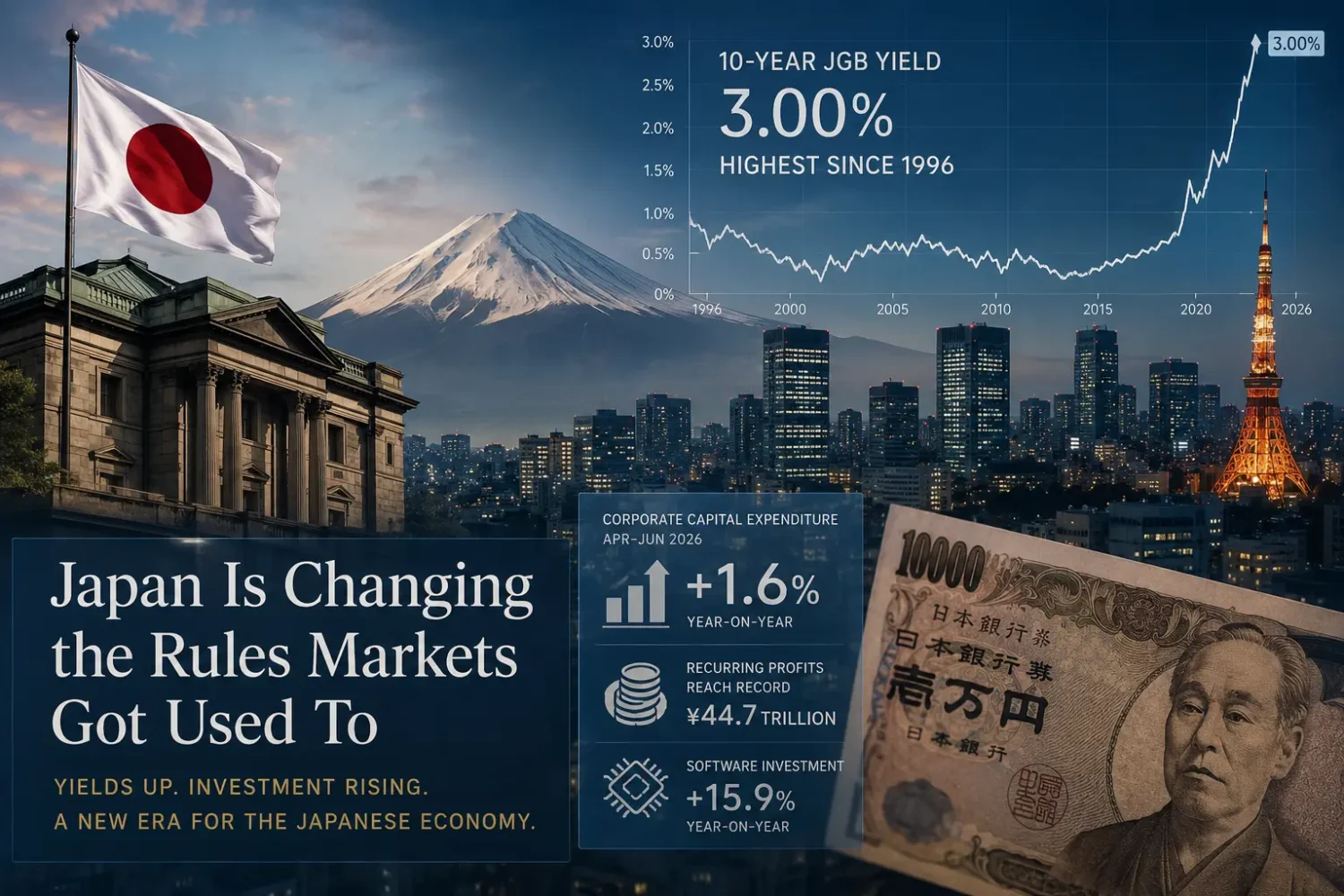
Japan’s benchmark 10-year government bond yield reached 3% on September 1, its highest level since 1996, as inflation concerns, fiscal questions and expectations surrounding monetary policy reshaped the country’s bond market.
Meanwhile, Japanese companies increased capital spending during the second quarter, the yen remains historically weak, and the Bank of Japan is operating with interest rates at levels Japan had not experienced for decades.
This isn’t one story about interest rates.
It is a broader change in the economic conditions that defined Japan for much of a generation.
Japan Just Crossed a 30-Year Bond-Market Line
The most visible change came from Japan’s government bond market.
The benchmark 10-year Japanese government bond yield reached 3% at the beginning of September, according to Reuters.
Japan had not seen that level since September 1996.
The number stands out because extremely low government borrowing costs were one of the defining characteristics of Japan’s financial system for years.
At various points during the country’s long experiment with unconventional monetary policy, government bond yields were close to zero or even negative.
The current environment looks very different.
Inflation has returned as a major policy concern. Energy prices have added pressure. Fiscal questions have become more prominent, while expectations surrounding future Bank of Japan policy have also changed.
The result is a Japanese bond market operating under conditions that would have appeared highly unusual only a few years ago.
Companies Are Still Spending
The bond market isn’t the only place where Japan’s economic landscape is changing.
Japanese companies increased capital expenditure by 1.6% from a year earlier during the April-June quarter, according to Ministry of Finance data.
The figure represented a notable acceleration from the previous quarter.
Corporate sales increased 5.9%, while recurring profits reached a record ¥44.7 trillion.
Those figures add another dimension to the Japanese story.
Higher borrowing costs and inflation concerns are developing alongside continued corporate spending and historically strong profits.
Government policy has also placed increasing emphasis on investment in artificial intelligence, semiconductors, advanced manufacturing and energy infrastructure.
Rather than pointing to a single conclusion about the economy, the figures show several changes taking place simultaneously.
Maezawa Daniel: Japan Has Several Stories Happening at Once
That overlap is what Maezawa Daniel, Broker at MizoraTrade, finds notable about the current environment.
“Japan isn’t experiencing just one adjustment. Interest rates, government bond yields, corporate investment, inflation and the currency are all part of the same broader economic picture. Looking at any one of them without the others can miss an important part of what is changing,” Daniel says.
His observation reflects the unusual combination visible in the latest data.
Bond yields are at levels unseen in three decades.
Corporate profits have reached records.
Business investment is increasing.
Inflation remains a policy concern.
And the yen continues to trade at historically weak levels against the U.S. dollar.
None of those developments, by itself, describes the Japanese economy.
Together, however, they illustrate how far the environment has moved from the conditions that characterized Japan for much of the previous two decades.
The Bank of Japan Is Operating in a Different World
Japan’s monetary-policy backdrop has also changed substantially.
The Bank of Japan currently guides the uncollateralized overnight call rate at around 1.0%.
That number may still appear low compared with rates seen elsewhere in the world.
For Japan, it represents a significant departure from the ultra-low and negative-rate environment that dominated much of its recent economic history.
The BOJ has been gradually moving away from extraordinary monetary settings while continuing to assess inflation, wages, economic activity and financial conditions.
Its next monetary-policy meeting is scheduled for September 17 and 18.
A late-August Reuters poll found that economists expected the BOJ to raise its key policy rate to 1.25% in September.
That remains a forecast rather than a policy decision.
The distinction matters because expectations surrounding central banks can change as economic information changes. The BOJ itself will determine policy at its scheduled meeting.
Then There Is the Yen
Japan’s currency adds another layer.
The yen weakened beyond 160 per U.S. dollar on September 1, despite growing expectations surrounding additional monetary tightening.
Japanese authorities have already taken extraordinary measures in response to currency weakness.
Finance Ministry data showed that Japan spent a record ¥15.4 trillion supporting the yen between late July and late August, including intervention involving coordination with the United States and South Korea.
The episode demonstrates how many variables can influence a currency simultaneously.
Interest-rate differences between countries are part of the picture, but so are inflation, energy imports, economic growth, fiscal policy, international capital flows and expectations about future monetary policy.
“Currencies reflect expectations about more than today’s interest rate,” Daniel says. “Inflation, future policy, economic growth and international capital flows are all part of the wider picture. The yen illustrates how several economic forces can be present at the same time.”
That is an explanation of the economic environment, rather than a prediction about where the currency goes next.
Japan’s Weak Yen Has Two Sides
The currency’s importance also extends into the corporate economy.
Japan is home to major manufacturers with substantial international operations. When overseas revenue is converted into yen, exchange-rate changes can affect the reported value of those earnings.
At the same time, Japan imports much of the energy it consumes.
A weaker currency can therefore increase the yen-denominated cost of imported fuel and other goods.
Those two effects can exist simultaneously.
A currency movement that changes reported overseas earnings for multinational companies can also affect import costs elsewhere in the economy.
That helps explain why the yen appears repeatedly in discussions about Japanese corporate profits, inflation and monetary policy.
A Global Story, Not Just a Japanese One
Japan’s changing financial environment also matters beyond its borders because of the country’s scale.
Japanese institutions, companies and households collectively hold enormous pools of financial assets, including investments outside Japan.
For many years, extremely low domestic interest rates formed part of the background to international capital flows originating from the country.
That historical backdrop is now changing as Japanese yields move higher.
This doesn’t establish where capital will move or how international markets will respond.
It does mean that one of the world’s largest developed economies is no longer operating under the same interest-rate conditions that characterized it for decades.
“When an economy has operated under very low interest rates for such a long period, those conditions become part of the financial landscape,” Daniel says. “When the conditions change, the economic relationships surrounding them can change as well.”
Japan Is No Longer the Exception It Used to Be
For years, Japan could almost be described through a familiar collection of economic characteristics:
Very low interest rates.
Very low government bond yields.
Persistent difficulty generating inflation.
A central bank operating extraordinary monetary policies.
That description no longer fits as neatly.
The 10-year government bond yield has reached 3%.
The Bank of Japan’s policy rate is around 1%.
Corporate capital spending is increasing.
Corporate profits have reached record levels.
Inflation has returned as a significant economic issue.
And the yen remains at the center of an unusually complicated interaction between domestic policy and the international economy.
The significance of Japan’s current transition isn’t that any one of those numbers determines what happens next.
It is that so many long-standing features of the Japanese economy are changing at the same time.
For Maezawa Daniel, that is the more important story.
Japan spent decades being treated as the global economy’s low-rate exception.
The economic conditions behind that reputation are now being rewritten.