
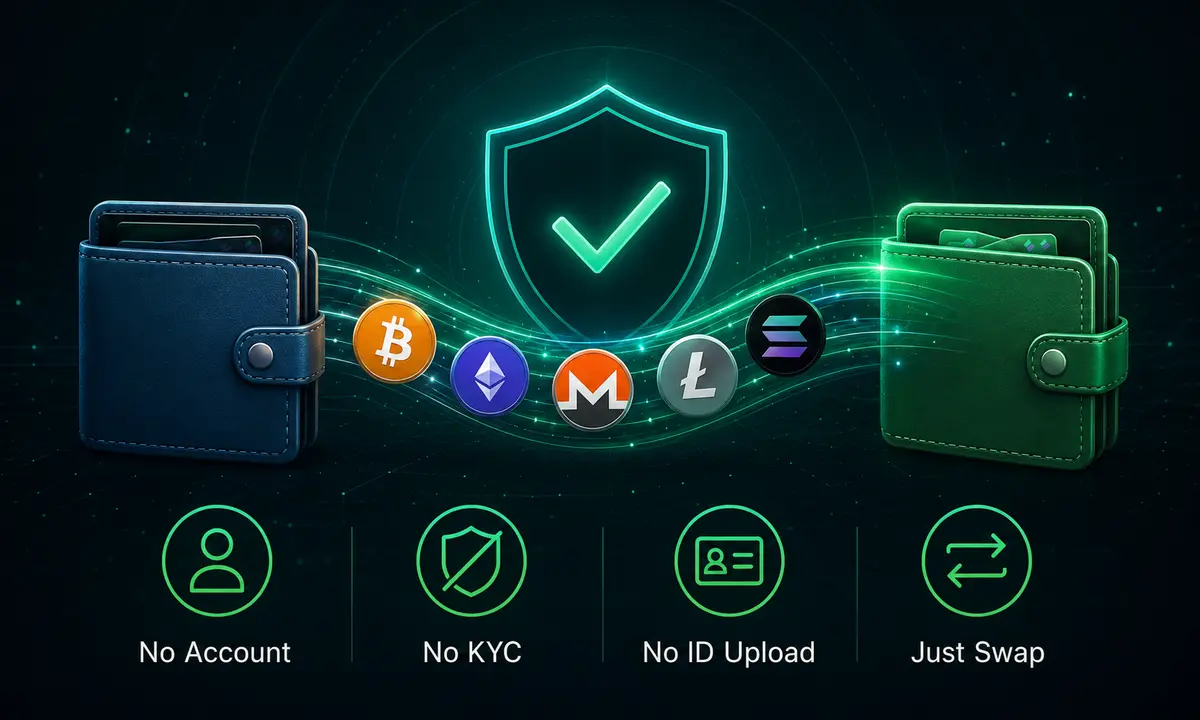
If you have ever looked for a no-KYC crypto exchange, the appeal is easy to understand. Instead of opening an account, sharing personal details, and uploading an ID, you may be able to swap one cryptocurrency for another with far fewer steps.
However, “no-KYC” is often interpreted too broadly. It does not automatically mean that it is anonymous, untraceable, or free from compliance checks. In most cases, it simply describes how identity verification works during a standard crypto swap.
Understanding that difference can help you make a more informed choice, especially if privacy and control over your crypto matter to you.
What Does a No-KYC Crypto Exchange Actually Mean?
KYC stands for Know Your Customer, which is the process a company uses to verify a customer’s identity. Traditional crypto exchanges often connect this process to an account, asking users for personal details and identity documents before providing access to certain services.
A crypto exchange without KYC may allow standard crypto-to-crypto swaps without those routine steps. You can typically choose the assets you want to exchange, provide a receiving wallet address, and complete the swap without maintaining a permanent exchange account.
Still, several terms that sound similar have very different meanings.
| Term | What it actually means |
|---|---|
| No account | You do not need a permanent user profile for a standard swap |
| No routine KYC | Identity documents are not normally required before swapping |
| AML screening | A transaction can still be checked for compliance risks |
| Pseudonymity | Your wallet does not directly show your identity, but its activity may be visible on chain |
Can a No KYC Exchange Still Perform AML Checks?
Yes. No KYC and no AML are not the same thing.
AML stands for Anti-Money Laundering and covers controls used to identify potentially suspicious activity, sanctions exposure, and other financial risks. These controls can include blockchain analytics and transaction screening without requiring every customer to verify their identity in advance.
As a result, a standard swap may proceed without an ID request, while a transaction that triggers a compliance review may be treated differently. Depending on the provider and its policies, additional information can be requested before the transaction is completed.
A useful way to think about it is:
- Routine verification applies as a normal condition of using a service.
- Conditional verification can arise from a specific transaction or a compliance review.
- AML screening can take place even when routine identity verification is absent.
Therefore, users should look beyond claims such as “no KYC” and check what the provider says about transaction reviews and possible verification requests.
Does No KYC Make a Crypto Swap Private?
A private crypto swap can involve less personal information, but that does not make the transaction invisible. This is because service privacy and blockchain privacy are separate.
When you make a swap without an account or routine identity verification, the service may collect less identifying information from you. Yet, transactions on public blockchains can still leave visible records, including wallet addresses, amounts, and transaction histories.
For example, swapping Bitcoin without uploading an ID does not remove the Bitcoin transaction from the blockchain. If a wallet address has been linked to your identity elsewhere, avoiding KYC for a single swap does not automatically sever that connection.
This is why crypto transactions are often better described as pseudonymous rather than anonymous. No KYC can affect the information a service collects, but it does not alter the underlying transparency of a public blockchain.
Why Custody Is Just as Important as KYC
Privacy is only one part of choosing an exchange. You should also understand who handles your funds.
On a custodial exchange, users may keep assets in an account controlled by the platform. A non-custodial swap model does not maintain a platform-controlled customer balance. In an aggregator flow, the user selects a provider, sends the deposit to that executing provider, and the destination asset is paid to the wallet address the user supplies. Aggregators add another distinction because they may compare providers rather than execute every swap themselves.
For example, Monivo compares liquidity providers that support the user’s selected asset pair, network, and amount. Its no KYC crypto exchange comparison examines individual providers and considers factors such as verification requirements, custody, and possible AML holds.
This matters because the provider executing the swap may also be responsible for receiving the deposit and applying its compliance policy. If that provider places a transaction under review, the aggregator may not control the funds or reverse the provider’s decision.
Before using a no-account crypto exchange, it is useful to check:
- who receives your crypto during the swap;
- whether customer balances are held by the service;
- which provider actually executes the transaction;
- what happens if AML screening flags the deposit;
- what amount is expected to reach your wallet.
These questions provide a much clearer picture of how a service works than the “no KYC” label by itself.
Crypto to Crypto Swaps and Fiat Purchases Are Different
A no-KYC policy for crypto swaps should not be assumed to apply to fiat transactions.
A crypto-to-crypto swap starts with digital assets the user already owns. Buying crypto with a card or bank transfer introduces traditional payment infrastructure and often involves external payment providers with separate compliance requirements.
The difference can be summarized simply:
| Transaction | Typical consideration |
|---|---|
| Crypto to crypto | May be available without routine identity verification |
| Card to crypto | Payment provider verification requirements may apply |
| Bank transfer to crypto | Banking and payment partner requirements may apply |
Therefore, a no-account crypto exchange may allow crypto swaps without registration while still directing fiat purchases through partners that require identity verification. Always check the rules for the specific transaction rather than assuming that one verification policy applies to every service on a platform.
How to Evaluate a No-Account Crypto Exchange
The best way to compare services is to follow the transaction from beginning to end.
First, confirm whether registration or routine identity verification is required for the type of swap you want to make. Next, read the compliance policy to understand when additional information may be requested.
Then consider custody. Identify the company that receives the deposit and the provider responsible for executing the swap. This is particularly important with aggregators because the interface you use and the provider handling your funds may be different companies.
Finally, look at the expected amount that will reach your wallet. An attractive headline rate does not always reflect the final outcome, as spreads, provider fees, and network costs can affect the amount received.
In practical terms, a good comparison should answer four questions:
- Verification: What information is normally required?
- Compliance: What happens if a transaction is flagged?
- Custody: Who handles the funds during the swap?
- Value: How much crypto is expected to reach the destination wallet?
Together, these factors provide a more meaningful basis for choosing a service than a single privacy claim.
Final Thoughts
A no-KYC crypto exchange can make crypto swaps simpler and more private, but no KYC does not mean complete anonymity. AML checks may still apply, and blockchain activity can remain visible.
The key is to look beyond the label. Understand who handles your funds, when verification may be required, and what remains visible on the chain. In crypto, real privacy starts with knowing how the swap actually works.