

 Maczo reports that its observed Player Win Rate increased by 70% in the period after the crypto gaming platform expanded Provably Fair verification and removed routine document-based KYC from standard play.
The combination reflects a wider shift in crypto product design. Wallets are no longer only a payment rail. They can be part of an account, a source of transaction context and a way to preserve user control. At the same time, cryptographic proofs can expose how digital outcomes are created.
The 70% figure comes from Maczo’s internal data and refers to a relative increase in observed Player Win Rate. The company has not published the starting and ending rates, game scope, measurement window, sample size or calculation method. It should be viewed as an internal observation rather than a guarantee.

Wallet Control Creates a Different Starting Point
Traditional digital accounts begin with a legal identity and add payment information afterward. Crypto-native accounts can begin with control of a wallet.
That does not prove who a person is, but it can prove that the user can authorize transactions from a specific address. Public blockchain history also gives a platform information about transaction flows without requiring a copy of a passport from every ordinary user.
Maczo’s AML policy says withdrawals are directed only to wallets controlled by the account owner. It also describes blockchain analytics, sanctions screening and behavioral monitoring for higher-risk activity.
This approach separates two questions that are often combined. The platform can assess whether funds and transaction behavior present risk without automatically collecting a complete offline identity document at the beginning of every relationship.
Provably Fair Adds Proof at the Product Layer
Wallet control does not explain whether a game result is fair. That requires a separate proof.
The Maczo Help Center describes a commit-and-reveal process built around a secret server seed, a player-controlled client seed and an incrementing nonce. Before play, the platform publishes a hash that commits it to the server seed.
After the seed is revealed, the user can confirm the hash and repeat the deterministic calculation. Changing the committed seed would create a mismatch.
Maczo also publishes source code for its original games. The repositories show how cryptographic output is converted into game-specific results such as wheel positions, dice values, multipliers or card order.
This matters because a valid hash is not the entire story. Users need to see that the same inputs recreate the result displayed on screen.
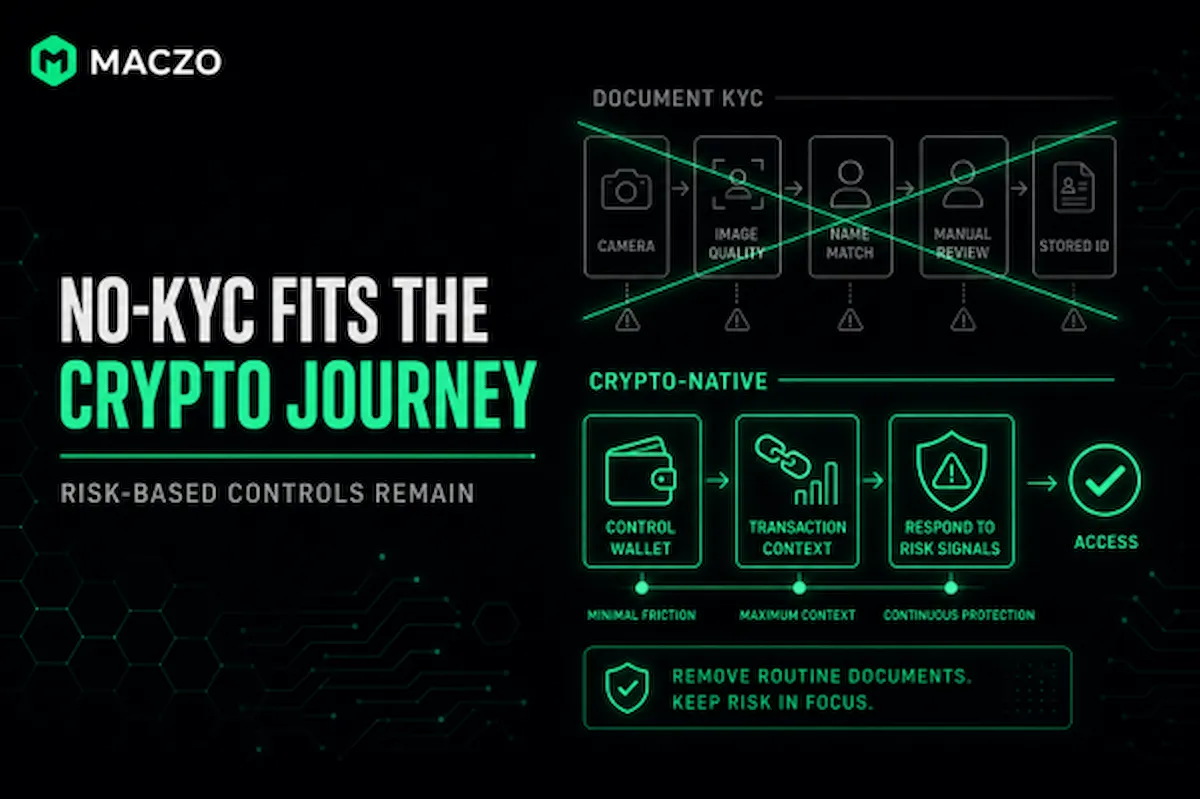
Why No-KYC Fits a Crypto-Native Journey
Document KYC can introduce several points of failure: camera access, image quality, name matching, manual review and secure storage of a permanent identity record.
Maczo says identity documents are not required for standard play or withdrawals. Users still need to meet age and jurisdiction rules, use lawful funds, provide accurate account information and follow account-security requirements.
The model aims to keep the ordinary journey closer to the way crypto users already interact: control a wallet, evaluate transaction context and respond to risk signals. Stronger intervention can be directed toward suspicious activity instead of applied as a document request to everyone.
How the Trust Model Relates to the Win Rate Update
The platform is effectively asking for two different proofs.
The user proves control of an account and wallet. The platform proves that a game result followed committed inputs and published rules.
When both sides can demonstrate what matters without excessive disclosure, the relationship becomes more balanced. Onboarding can become shorter while the product becomes easier to inspect.
That model can reduce onboarding friction and make outcomes easier to inspect, but it does not mechanically raise a player’s odds. Maczo’s reported 70% increase in observed Player Win Rate occurred during the same period and may also reflect game mix, player choices, stakes, sample composition and variance.
The timing does not establish causation. Provably Fair verifies that published logic produced a recorded result; it does not increase the probability of a win.
What Crypto Platforms Can Learn
The first lesson is to avoid treating no-KYC as a slogan. A credible policy should explain what controls remain, how suspicious activity is handled and what responsibilities apply to users.
The second is to make verification practical. Documentation, browser tools, source code and test vectors reduce the distance between a cryptographic claim and an action a user can perform.
The third is to publish better metrics. Reporting the starting and ending Player Win Rate, game scope, sample size, calculation method and comparison dates would make Maczo’s result easier to evaluate.
Crypto products often promise speed and user control. Maczo’s update suggests that the stronger opportunity may be a complete trust model: less unnecessary personal data, more risk context from public networks and reproducible evidence at the product layer.
The reported Player Win Rate change deserves continued measurement. The durable wallet-native claim is separate: users can begin with less routine document collection while receiving more evidence about how digital outcomes are produced.